
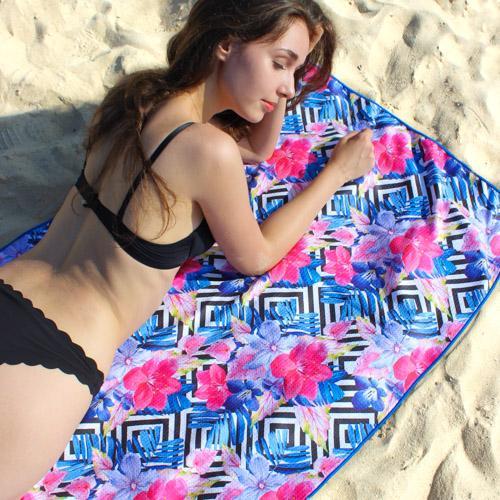
How Sand-Free Beach Towels Work: A B2B Guide
How sand-free beach towels work: double-weave, anti-adhesion & tight-knit engineering for shake-off performance. A B2B sourcing guide for resort pool, surf-school rental, and private-label programs evaluating anti-adhesion towel construction at OEM MOQs.
If you've spent a beach day shaking out a sandy terry cotton towel, you've already met the engineering problem that sand-free beach towels are built to solve. The technology isn't magic and isn't a coating that "wears off" — it's a deliberate fabric architecture, an anti-adhesion surface treatment, and a shake-off physics principle that together produce the one-snap-clean performance buyers now expect. For B2B procurement teams placing OEM orders, understanding how sand resistant towel technology actually works is the difference between buying a marketing claim and buying a measurable specification.
This guide explains the engineering, walks through the three fabric families on the market today, and gives B2B buyers a procurement checklist — GSM ranges, durability tests, colorfastness requirements, and supplier qualification criteria — for evaluating sand-free towel programs before signing a purchase order.
1. The Science Behind Sand-Free Towel Technology
Three engineering layers explain why a properly engineered sand-free towel releases sand in one or two snaps while standard cotton terry holds onto grit for the entire car ride home.
1. Tight-weave surface architecture. Terry cotton uses looped piles — the loops that make terry soft and absorbent are also the gaps where sand grains anchor. Tight-weave constructions close that gap. Tight-weave microfiber face fabrics use a flat or finely textured polyester weave at 250–350 GSM with negligible loop depth, so sand grains sit on top instead of nesting inside. Open woven mesh goes further — visible voids let sand fall through under gravity. Both eliminate the physical anchoring mechanism that traps sand in terry loops.
2. Anti-adhesion surface treatment. A nanoscale anti-adhesion coating applied during finishing reduces the friction coefficient between sand particles and the textile surface, so grains can't form a strong bond. Independent mill testing (20g ISO test sand, 10 controlled shake cycles, 30 cm drop height) typically returns under 1g residual on tight-weave microfiber versus 8–12g on cotton terry — an order-of-magnitude difference that translates directly into the shake-off experience beachgoers notice.
3. Shake-off physics. Reduced surface friction + minimal fiber gaps = grains slide off rather than lock in. The towel doesn't need a brush, rinse, or machine cycle — one sharp shake, fold, or brisk wind does the work. That's the underlying principle behind every credible shake-off claim — and why shake-off performance is now the leading spec resort and surf-school buyers demand.
The practical implication: when a supplier tells you their towel is "shake-off capable," ask which of the three engineering layers is doing the work. If they can't name at least two — fabric architecture and a measurable shake-off result — the claim is marketing, not engineering.
2. Types of Sand-Free Towel Fabrics
Not all sand-free constructions are equal. Three fabric families dominate the B2B market, each tuned to a different performance and price profile.
2.1 Tight-Weave Microfiber — The Volume Standard
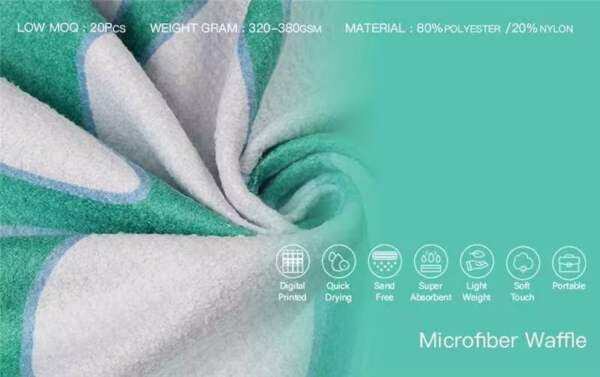
Tight-weave microfiber at 250–350 GSM is the highest-volume shake-off construction. The smooth polyester face accepts sublimation for full-bleed prints, the microfiber backing provides absorbency, and the tight surface leaves no gaps for sand to anchor. This is the workhorse fabric for custom beach towels sold through resort pool decks, surf-school rentals, and travel-retail pouches — the default SKU for most Suzhou factory-direct suppliers.
Best for: promo SKUs, sublimation resort programs, travel retail. Price tier: entry to mid.
2.2 Open Woven Mesh — The Lightweight Specialist
Open woven mesh at 200–280 GSM is the lighter alternative. The mesh has visible voids, so sand falls through the weave entirely. Favored by surf schools and beach clubs running high-turnover rental sets, and by travel-retail brands wanting paperback-size packability. The trade-off is absorbency — mesh dries fastest but absorbs least, so it's often paired with a microfiber binding or terry panel at the headrest zone.
Best for: surf schools, watersports rentals, travel retail. Price tier: mid.
2.3 Hybrid Constructions — The Premium Tier
Premium shake-off towels use hybrid construction: tight-weave microfiber face for sand release + soft-loop cotton or bamboo back for plush hand-feel. This addresses the most common complaint about pure microfiber — it doesn't feel as soft as terry. The hybrid commands a 15–25% price premium at retail and is the construction brands like TESALATE popularized for consumer-direct. For B2B, hybrid is right when positioning a premium private-label line that needs both shake-off performance and terry-competitive hand-feel.
Best for: premium private-label, gift-shop retail. Price tier: premium (20–40% above microfiber).
2.4 GSM Comparison Across Constructions
| Construction | GSM Range | Sand Release Mechanism | Absorbency | Print Compatibility | Price Tier |
|---|---|---|---|---|---|
| Tight-weave microfiber | 250–350 | Surface friction + tight weave | Medium-high | Sublimation / screen | Entry–mid |
| Open woven mesh | 200–280 | Gravity (sand falls through voids) | Low | Limited (heat-transfer) | Mid |
| Hybrid (microfiber face + cotton back) | 350–500 | Surface friction + tight weave | High | Sublimation face / screen back | Premium |
| Cotton terry (reference, no shake-off) | 400–900 | None — sand traps in loops | Highest | Screen / DTG | Entry–premium (varies by GSM) |
For B2B buyers building an anti-sand beach towel manufacturer sourcing spec, the GSM band tells you most of what you need to know: below 280 GSM is the lightweight travel/mesh tier; 250–350 GSM is the volume microfiber tier; 350+ GSM is the hybrid premium tier. Resist quotes that don't disclose GSM — it's the single most predictive spec for both performance and landed cost.
3. What B2B Buyers Should Look for in Sand-Free Towel Suppliers
A "sand-free" claim on a sell sheet is not a spec. The engineering only matters if it survives shipping, washing, and a season of beach use. Here's the supplier qualification checklist.
3.1 Demand the Lab Test, Not the Brochure
Ask for the shake-off test methodology and result. The repeatable industry protocol: 20g ISO standard test sand (grain size 0.1–0.5 mm), 30×30 cm towel sample, 10 controlled shake cycles at 30 cm drop height, residual weighed to 0.1g. A credible tight-weave microfiber returns under 1g residual; cotton terry returns 8–12g. If the supplier can't produce a number — or describe the test — they aren't running the engineering. Use the same protocol as the third-party witnessable qualification report required before bulk release.
3.2 Specify GSM, Construction, and Coating in the PO
A sand-resistant towel PO should explicitly name three things: construction family (tight-weave microfiber, open woven mesh, or hybrid — not "shake-off fabric"); GSM range with tolerance (e.g. 280–320 GSM for tight-weave microfiber volume runs); and anti-adhesion coating (topical finish vs. yarn-level treatment — the former attenuates after 20–30 wash cycles, the latter survives 80+). For resort amenity programs running daily laundering, this distinction is the difference between a one-season and a three-season SKU.
3.3 Colorfastness, Certifications, and Capacity
Shake-off microfiber is printed via dye sublimation, which enters the polyester fiber under heat — excellent wash and light fastness with no surface ink to rub off. Specify the production sequence: sublimation first, anti-adhesion finish second (reversing it interferes with dye uptake). For sand-proof towel fabric technology sold into resort and outdoor programs, the minimum colorfastness floors are wash Grade ≥ 4 (ISO 105-C06) and light Grade ≥ 5 (ISO 105-B02).
Certifications worth requiring: OEKO-TEX Standard 100 Class 2 (skin-contact minimum), GRS for recycled-polyester programs, Sedex SMETA 4-Pillar (most EU and UK retail), and ISO 9001. A factory with no certifications and no certified partners is a flag for any retail or hospitality program.
For a shake-off towel bulk wholesale program, the Suzhou factory-direct benchmark is MOQ 50 pieces per design — low enough for private-label test runs, high enough to protect mill economics. Sample lead time runs 5–7 days; bulk production 25–35 days for 1,000–3,000 pieces. Sub-15-day bulk lead time at this MOQ is almost certainly trading off inspection time — exactly where shake-off performance gets compromised.
4. Sand-Free vs Regular Beach Towels — A Procurement Comparison
Side-by-side at the same price point, sand-free and standard terry beach towels solve different problems and sell to different end users.
| Dimension | Shake-Off (Microfiber / Mesh) | Standard Cotton Terry |
|---|---|---|
| Sand release | One shake; <1g residual | 8–12g residual; requires brushing or rinse |
| Drying time | 30–60 min air-dry | 2–4 hours air-dry; prone to mildew if stored damp |
| Weight (per piece) | 280–500g | 500–900g |
| Pack / shipping density | 6–10 pcs per kg | 1.5–3 pcs per kg |
| Print method | Dye sublimation (full-bleed photo) | Screen print / DTG (limited colors) |
| Hand-feel | Smooth, slick; some consumers prefer terry plush | Soft loop pile; classic towel feel |
| Durability (wash cycles) | 80–150+ with proper care | 150–300+ |
| Best channel | Resort pool, surf school, travel retail, beach club | Home bath, hotel amenity, traditional retail |
| Price band (FOB) | $3.50–$7.50 per piece at MOQ 500 | $4–$12 per piece at MOQ 500 (varies by GSM) |
| Lead time | 25–35 days | 30–45 days |
For buyers building a custom beach towels line that spans both audiences, the typical commercial strategy is a dual-SKU program: shake-off for outdoor / travel / resort channels, terry cotton for home bath and traditional retail. The two constructions don't compete — they sell into different use cases and price tiers.
The one decision rule that resolves most line-planning debates: if the end user carries the towel more than 50 meters from a car, shake-off is the right construction. If the towel lives primarily in a bathroom, terry cotton wins on hand-feel and absorbency.
5. Frequently Asked Questions
Are sand-free towels really sand-free?
No honest manufacturer will claim "zero sand." The accurate claim is "shake-off performance" — a properly engineered shake-off microfiber releases the vast majority of sand grains in one or two sharp shakes. Independent mill testing (20g sand load, 10 shake cycles) typically returns under 1g residual versus 8–12g on cotton terry. That's not zero, but it is the difference between a clean car seat and a beach's worth of grit in your tote bag. If a supplier claims literal "sand-free" with no qualification, ask for the test number.
How do you test sand-free claims before placing a bulk order?
Run the shake-off test yourself. Order a sample, weigh 20g of ISO standard test sand (or fine playground sand if you don't have ISO sand on hand), spread it evenly across the sample, shake the towel 10 times in a controlled drop, and weigh the residual. A shake-off microfiber returns under 1g; cotton terry returns 8g or more. Take photos, document the protocol, and attach it to your supplier qualification file. A supplier that welcomes the test has the engineering; one that resists the test does not.
Do sand-free towels work as well after repeated washing?
The answer depends on whether the anti-adhesion treatment is topical or yarn-level. Topical finishes begin to attenuate after 20–30 wash cycles; yarn-level treatments survive 80+ cycles. For a resort amenity program running daily laundering, this is the single most important spec to confirm in the purchase order. For a consumer retail SKU washed weekly, either construction holds up over a typical one-to-two-season use cycle. Either way, avoid fabric softener — it coats the anti-adhesion surface and degrades shake-off performance regardless of construction.
Can sand-free towels be custom printed with a brand logo?
Yes — and this is one of the engineering advantages. Dye sublimation on polyester microfiber accepts full-bleed photographic prints with unlimited colors and sharp edge definition. For anti-sand beach towel manufacturer sourcing, sublimation is the default decoration method for shake-off constructions; screen printing and embroidery are also viable but typically used as accent layers over a sublimated base. Custom logos, edge-to-edge graphics, and Pantone-matched brand colors all reproduce cleanly on tight-weave microfiber.
6. Making the Right Sourcing Decision
Shake-off beach towels aren't a fad — they're the engineering answer to a real consumer complaint, and the spec is now reproducible, testable, and commercially scalable at OEM MOQs. The path forward for B2B buyers: anchor the sourcing spec on the three engineering layers, demand the lab test alongside the brochure, and require GSM, construction, and coating disclosure in every purchase order.
Ready to specify a shake-off beach towel program — resort pool deck, surf-school rental fleet, promotional retail, or private-label consumer brand? Start with our shake-off spoke page for GSM tiers, MOQ/lead-time benchmarks, and the live supplier qualification pack. Then request a sample kit with shake-off documentation and move into a factory-direct OEM conversation.
For programs prioritizing drying speed, see our quick dry beach towels construction guide — same microfiber and tight-weave base, with drying-time benchmarks tuned for hospitality and travel retail.
Explore the full custom beach towels family — round, hooded, microfiber, custom-printed — from the beach towel hub. For shake-off program evaluation, request an OEM sample pack with shake-off documentation, GSM verification, and OEKO-TEX / GRS certification from the sample CTA below.
Ready to specify a shake-off towel program at OEM MOQs? Contact our engineering team to request a sample kit with shake-off documentation, GSM verification, and OEKO-TEX / GRS certification. MOQ starts at 50 pieces per design with 5–7 day sample lead times.
Request Shake-Off Sample Kit